Automatic language translation
Our website uses an automatic service to translate our content into different languages. These translations should be used as a guide only. See our Accessibility page for further information.

Download or print this PDF checklist to assist parties.

Affidavits
An affidavit is written statement of facts to be used in proceedings before a court or tribunal that is sworn or affirmed to be true. It must be signed by the person making it in front of an authorised person, such as a solicitor or Justice of the Peace, who also signs it as a witness. It must be in a particular form, which is detailed below.
An affidavit is one form in which a person may give evidence in matters before the Industrial Relations Commission of New South Wales (Commission). The person who makes the affidavit is called the deponent.
The parties, or other witnesses, may give their evidence to the Commission by affidavit. This might be the applicant; the respondent; or a witness called by either party, including an expert witness.
When an affidavit is filed as evidence to the Commission, a copy of the affidavit should be served on all parties to the proceeding.
When to use an affidavit at the Commission?
When a party is directed to file evidence by a certain date that party can ordinarily choose to meet that requirement by filing either witness statement that is merely signed, or an affidavit which is sworn or affirmed to be true in front of an authorised person. See also Preparing a Witness Statement. [CA1]
There are circumstances where an affidavit must be filed, rather than merely a signed witness statement. That might be because the Commission has directed that evidence be filed in affidavit form. It may be required by the Rules or a Practice Note. The most common examples of when an affidavit must be provided are set out below.
An application for an issue to be dealt with urgently will often require a Notice of Motion, accompanied by an affidavit setting out why the proceedings should be dealt with urgently.[1] [2]
An application for a consent award must be supported by an affidavit setting out the way in which the consent award provides equal remuneration and other conditions of employment for men and women doing work of equal or comparable value. The affidavit must also explain why the consent award is in the public interest having regard to the matters set out in section 162(2) of the Industrial Relations Act 1996 (NSW) (IR Act).[3]
An application for approval of an enterprise agreement or contract agreement must be accompanied by an affidavit that:
The Commission, sitting as the Industrial Court, may require the applicant in proceedings for a contravention of dispute orders and other offences under the IR Act to file an affidavit in support of the application that verifies:
An application to the Commission to declare a contract void or varied under s 106 of the IR Act must be accompanied by an affidavit that verifies the issues set out in the application. Any reply or response from the applicant or respondent must also be accompanied by an affidavit.[6]
An affidavit must be filed with an Application for Leave to introduce fresh evidence on appeal that sets out:
· the nature of the fresh evidence;
· the reason the fresh evidence was not introduced at first instance; and
· the reasons the fresh evidence is necessary in the appeal.[7]
Additionally, any evidence in support of a charge for contempt of the Commission must be by affidavit.[8]
The applicant in proceedings for a contravention of dispute orders and other offences under the IR Act must serve a summons and a copy of an affidavit verifying service no later than five (5) days before the return date of the summons.[9]
An affidavit must be filed with a Notice of Motion when seeking leave (permission) to issue a summons in an appeal.[10]
The prosecutor in WHS proceedings must file an affidavit in support of the application that verifies the allegations and a minute of the order sought.[11]
The person who serves a document on another party may complete an Affidavit of Service signed before an authorised witness such as a Justice of the Peace (JP). An affidavit of service must contain:
What should be included in an affidavit?
An affidavit should only include facts that the person who is making the affidavit knows to be true to the best of their knowledge or belief.
An affidavit should only contain facts relevant to an issue in dispute. Under Part 35 of the Uniform Civil Procedure Rules 2005 (NSW) (UCPR), the deponent must only include and swear to facts that are within their own personal knowledge or experience.[15]
Whether evidence is relevant will depend on the type of claim and if there is a logical connection between the information provided in the affidavit and an issue in dispute.[16] The evidence will be relevant if it could rationally affect the decision-maker's assessment of the probability of the existence of a fact in issue.[17]
See also Preparing a Witness Statement. [CA2]
Can I use generative artificial intelligence?
No. Generative artificial intelligence (GenAI) tools must not be used, without leave of the Commission,[18] to generate the content of an affidavit, annexure or exhibit. This includes using GenAI to alter, embellish, strengthen, dilute or rephrase a deponent’s evidence.[19]
An affidavit must include a statement that GenAI was not used to generate the content.[20]
Read the Commission’s Practice Note No 33 on the Use of GenAI.
How to file an affidavit
An affidavit can be filed through the NSW Online Registry. Alternatively, the affidavit can be submitted by email, post or in-person at the Commission.
Affidavits must not be filed unless it is filed in accordance with Part 35 of the UCPR, Industrial Relations Commission Rules 2022 (NSW) and the Commission’s Practice Notes.
Format of the affidavit
The deponent must include their name and the date on which the affidavit was made in the heading of the document.[21]
The deponent must state the following on the first page:
Court or Commission Whether the matter will be heard at the Industrial Relations Commission of NSW OR the Industrial Court of NSW;
Case number The unique identifier assigned to your matter;
Title of Proceedings Details of the parties in the matter;
Filing details Contact details for the person filing the affidavit.
Image 1 The sections of the affidavit that must be completed highlighted in red.
Page two must:
Image 2 The sections of the affidavit that must be completed highlighted in red.
Jurat
The jurat or signature panel at the end of the affidavit is where the deponent and the authorised witness both sign the document. The jurat cannot appear on the last page alone. There must be at least one paragraph of text before the jurat.
An authorised witness under section 26 of the Oaths Act 1900 (NSW) (Oaths Act) includes:
The Department of Communities and Justice has a JP Register that can be accessed here. An interpreter can be accessed through Service NSW if needed.
The deponent must sign the affidavit in the presence of the authorised witness. Every page of the affidavit must also be signed by the deponent and authorised witness.[23]
The authorised witness must see the face of the deponent[24] and confirm their identity with an approved identification document (ID) if they have not known them for at least 12 months.[25] The authorised witness may request any face covering that prevents identification to be removed unless an exemption applies.[26]
The approved ID must include the deponent’s photo, and the name on the ID must match the name on the affidavit.
Approved ID under Schedule 2 of the Oaths Regulation 2024 (NSW) (original or certified copy)[27] can include:
The document relied upon must not be expired, cancelled and must be in English (or provide a certified English translation).[28] Otherwise, the authorised witness will not be able to sign the affidavit.
Alterations to the affidavit
The affidavit may not be used if any text is inserted, erased or otherwise altered unless the authorised witness initials the change and, in the case of an erasure, rewrites in the margin of the affidavit any words or figures written on the erasure and signs or initials them.[29]
Annexures and exhibits
Annexures and exhibits can be used in conjunction with an affidavit.[30] An annexure is a document attached to the end of an affidavit that provides additional information, while an exhibit is a document or object referred to in an affidavit but kept separate from the document.
Annexures should be referred to by a bold letter in the affidavit. For example, “I emailed my boss on 1 October 2025. Annexed to this affidavit and marked with the letter ‘A’ is a copy of the email.” Write the identifying letter at the top of each annexure and attach the documents in alphabetical order at the back of the affidavit.
A party may file multiple affidavits with the Commission that refer to the same document. The same reference letter should be used if a secondary affidavit refers to a document that has been annexed to a previous affidavit. Any documents previously filed with the Commission should not be annexed to an affidavit.
Annexures and exhibits to an affidavit must be identified by a certificate endorsed by the authorised witness before whom the affidavit is made.[31]
An exhibit to an affidavit is something that cannot be filed, such as an audio or video recording.[32] The party must serve the exhibit in conjunction with the affidavit by:
· producing the exhibit for inspection by if any other party to the proceedings; or
· produce the exhibit at a convenient place to allow a copy to be made by the other party.[33]
Any person who wilfully and knowingly makes a false statement in the affidavit may be found guilty of perjury.[34] The prosecution must be commenced with the approval of the NSW Attorney General.[35]
Every person wilfully swearing falsely in any affidavit made before any authorised witness shall be deemed guilty of perjury and be subject to the same penalties that apply to a person who has wilfully sworn falsely in open Court.[36]
A statutory declaration is a written statement of fact(s) made by a person (declarant) who affirms the contents to be true. It must be signed in front of an authorised witness.
A statutory declaration must be written and signed by a natural person. A statutory declaration about a corporation or union’s affairs must be made and signed by an authorised officer of the corporation.
A statutory declaration must be taken by an authorised witness under section 21 of the Oaths Act 1900 (NSW) (Oaths Act), which includes:
· Registrar-General;
· Deputy Registrar-General;
· Justice of the Peace (JP);
· Notary public;
· Commissioner of the court for taking affidavits;
· Australian legal practitioner authorised by s 27(1) of the Oaths Act;
· Federal judicial officer; or
· any other person authorised under law to administer an oath.
The Department of Communities and Justice has a JP Register that can be accessed here. An interpreter can be accessed through Service NSW if needed.
An employee must provide a statutory declaration to their employer before the start of maternity leave and, if applicable, including the period of any leave sought or taken by their spouse.[37]
If an employee is seeking paternity, partner or adoption leave,[38] the statutory declaration should state the period of any leave sought or to be taken by their spouse, and whether they are seeking extended leave to become the primary caregiver of the child.[39]
An employer may ask an employee who applies for parental leave to provide a statutory declaration, or enter into an agreement, that states they will not engage in any conduct inconsistent with the employee’s contract of employment.[40]
The particulars set out in the unpaid remuneration claim must be verified by statutory declaration.[41]
Organisations may apply to the Commission to be registered under Part 3 of the Industrial Relations Act 1996 (NSW) (IR Act). The Industrial Registrar may require information in the application to be verified by statutory declaration and require proof of the authority of the applicants to act on behalf of the organisation concerned.[42]
In the case there is an objection to the application for registration, the notice of objection and an outline of ground(s), the facts and circumstances of the objection must be verified by statutory declaration.[43]
An application for inquiry concerning irregularity in election must specify the alleged irregularity and the facts relied on to support the allegation and lodged with a verified statutory declaration.[44]
The secretary of the organisation of a State organisation must lodge a statutory declaration that:
· certifies the register of members has, during the immediately preceding calendar year, been kept and maintained;
· certifies the copy of the records required to be kept under s 278 of the IR Act are a correct statement of the information contained in those records;[45] and
· certifies a notification of any change made to the records required to be kept under s 278 of the IR Act within 28 days.[46]
The declarant should write the statutory declaration before taking the document to the authorised witness. The statutory declaration, unless otherwise permitted under law, must be in the form referred to as the Eighth Schedule or the Ninth Schedule.[47]
The Department of Communities and Justice provide templates for the Eighth Schedule or the Ninth Schedule statutory declarations. The form chosen will depend on the purpose of the statutory declaration.
The declarant must include their full name, a statement of facts and a declaration that states the contents is true in the following format:
“I,(insert name), do solemnly and sincerely declare that [statement of facts], and I make this solemn declaration conscientiously believing the same to be true, and by virtue of the provisions of the Oaths Act 1900.”
The declarant must include their full name, address, the facts according to their knowledge, belief, or information and a declaration that states the contents is true in the following format:
“I, (name), of (address), do hereby solemnly declare and affirm that [the facts to be stated according to the declarant’s knowledge, belief, or information]. And I make this solemn declaration, as to the matter(s) aforesaid, according to the law in this behalf made—and subject to the punishment by law provided for any wilfully false statement in any such declaration.”
The declarant should make an appointment with the authorised witness, who must see their face[48] and may request any face covering that prevents identification to be removed unless an exemption applies.[49]
The authorised witness must confirm the declarant's identity with an approved identification document (ID) if they have not known them for at least 12 months[50] and the statutory declaration must be signed in front of the authorised witness.
The approved ID must include the declarant’s photo, and the name on the ID must match the name written on the statutory declaration.
Approved ID under Schedule 2 of the Oaths Regulation 2024 (NSW) (original or certified copy)[51] can include:
· a birth certificate;
· a valid NSW drivers licence, with the declarant’s photo (or digital driver licence);
· NSW Photo Card, with the declarant’s photo;
· Australian proof of age card, with the declarant’s photo
· the declarant’s Australian passport, either current or expired less than two years ago; or
· a passport or similar document, with the declarant’s photo and signature, issued by a country other than Australia or the United Nations (with a certified English translation if not in English. Service NSW provides a document translation service here).
The document relied upon must not be expired, cancelled and must be in English (or provide a certified English translation).[52] Otherwise, the authorised witness will not be able to sign the statutory declaration.
Any person who wilfully and corruptly makes or takes a false declaration is guilty of an offence and could be sentenced to five years;[53] or if the false declaration was made to derive a material benefit, the person could be imprisoned for up to seven years.[54]
Unauthorised witnesses or people who falsely pretend to be authorised are guilty of an offence under the Oaths Act.[55]
[1] Industrial Relations Commission Rules 2022 (NSW) r 3.3(1).
[2] Generally, s 130 Dispute Notifications can be notified to the Registrar directly, with a Notice of Motion.
[3] Ibid r 6.8(1).
[4] Ibid r 6.9.
[5] Ibid r 7B.2(3).
[6] Ibid r 7D.3(7).
[7] Ibid r 7.3.
[8] Ibid r 8.8A.
[9] Ibid r 7B.4.
[10] Ibid r 7.8.
[11] Ibid r 7C.3(2).
[12] Ibid r 35.8(2).
[13] Ibid r 35.3B(2).
[14] Ibid r 35.8(1).
[15] Uniform Civil Procedure Rules 2005 (NSW) r 35.3(3).
[16] Papakosmas v The Queen (1999) 196 CLR 297 at [81].
[17] Evidence Act 1995 (NSW) s 55(1).
[18] Uniform Civil Procedure Rules 2005 r 35.3B(3).
[19] Ibid r 35.3B(1).
[20] Ibid r 35.3B(2).
[21] Ibid r 35.3A.
[22] Oaths Act 1900 (NSW) s 26.
[23] Uniform Civil Procedure Rules 2005 (NSW) r 35.7B.
[24] Ibid s 34(1).
[25] Oaths Regulation 2024 (NSW) cl 5.
[26] Oaths Act 1900 (NSW) s 34(3); Oaths Regulation 2024 (NSW) cl 4.
[27] Ibid (NSW) cl 6(1).
[28] Ibid cl 6(2).
[29] Ibid r 35.5.
[30] Ibid r 35.6(1).
[31] Ibid 35.6(2)-(4).
[32] Ibid r 35.6(5).
[33] Ibid r 35.6(6).
[34] Ibid s 33(1).
[35] Ibid s 33(2).
[36] Ibid s 29.
[37] Industrial Relations Act 1996 (NSW) s 58(1)(d).
[38] Ibid s 58(3)(d).
[39] Ibid s 58(2)(d).
[40] Ibid s 58(6).
[41] Ibid s 129D(4).
[42] Ibid s 219(2).
[43] Ibid s 220(2).
[44] Ibid s 252(3)(c).
[45] Ibid s 278(3).
[46] Ibid s 278(4).
[47] Oaths Act 1900 (NSW) s 24.
[48] Oaths Act 1900 (NSW) s 34(1).
[49] Ibid s 34(3); Oaths Regulation 2024 (NSW) cl 4.
[50] Oaths Regulation 2024 (NSW) cl 5.
[51] Ibid (NSW) cl 6(1).
[52] Ibid cl 6(2).
[53] Oaths Act 1900 (NSW) s 25.
[54] Ibid s 25A.
[55] Ibid s 21A.
Affidavits and Statutory Declarations
An affidavit is written statement of facts to be used in proceedings before a court or tribunal that is sworn or affirmed to be true. It must be signed by the person making it in front of an authorised person, such as a solicitor or Justice of the Peace, who also signs it as a witness. It must be in a particular form, which is detailed below.
An affidavit is one form in which a person may give evidence in matters before the Industrial Relations Commission of New South Wales (Commission). The person who makes the affidavit is called the deponent.
The parties, or other witnesses, may give their evidence to the Commission by affidavit. This might be the applicant; the respondent; or a witness called by either party, including an expert witness.
When an affidavit is filed as evidence to the Commission, a copy of the affidavit should be served on all parties to the proceeding.
When a party is directed to file evidence by a certain date that party can ordinarily choose to meet that requirement by filing either witness statement that is merely signed, or an affidavit which is sworn or affirmed to be true in front of an authorised person. See also Preparing a Witness Statement. [CA1]
There are circumstances where an affidavit must be filed, rather than merely a signed witness statement. That might be because the Commission has directed that evidence be filed in affidavit form. It may be required by the Rules or a Practice Note. The most common examples of when an affidavit must be provided are set out below.
An application for an issue to be dealt with urgently will often require a Notice of Motion, accompanied by an affidavit setting out why the proceedings should be dealt with urgently.[1] [2]
An application for a consent award must be supported by an affidavit setting out the way in which the consent award provides equal remuneration and other conditions of employment for men and women doing work of equal or comparable value. The affidavit must also explain why the consent award is in the public interest having regard to the matters set out in section 162(2) of the Industrial Relations Act 1996 (NSW) (IR Act).[3]
An application for approval of an enterprise agreement or contract agreement must be accompanied by an affidavit that:
· identifies the awards or contract determinations, if any, over which the agreement will prevail;
· other enterprise agreements or contract agreements that will be rescinded or replaced if the agreement is approved;
· compare the conditions of employment or engagement under the agreement with the comparative conditions of employment;
· the conditions of employment or engagement under the agreement, if compared with the comparative conditions of employment, do not, considered as a whole, result in a net detriment to the employees covered by the agreement;
· the agreement complies with relevant statutory requirements, such as the Anti-Discrimination Act 1977;
· the parties understand the effect of the agreement;
· the parties did not enter into the agreement under duress; and
· the agreement complies with the principles set by the Commission under s 33 of the IR Act or that any departure from the principles does not prejudice the interests of the parties.[4]
The Commission, sitting as the Industrial Court, may require the applicant in proceedings for a contravention of dispute orders and other offences under the IR Act to file an affidavit in support of the application that verifies:
· the allegation made in the application; and
· a minute of the summons sought.[5]
An application to the Commission to declare a contract void or varied under s 106 of the IR Act must be accompanied by an affidavit that verifies the issues set out in the application. Any reply or response from the applicant or respondent must also be accompanied by an affidavit.[6]
An affidavit must be filed with an Application for Leave to introduce fresh evidence on appeal that sets out:
· the nature of the fresh evidence;
· the reason the fresh evidence was not introduced at first instance; and
· the reasons the fresh evidence is necessary in the appeal.[7]
Additionally, any evidence in support of a charge for contempt of the Commission must be by affidavit.[8]
The applicant in proceedings for a contravention of dispute orders and other offences under the IR Act must serve a summons and a copy of an affidavit verifying service no later than five (5) days before the return date of the summons.[9]
An affidavit must be filed with a Notice of Motion when seeking leave (permission) to issue a summons in an appeal.[10]
The prosecutor in WHS proceedings must file an affidavit in support of the application that verifies the allegations and a minute of the order sought.[11]
The person who serves a document on another party may complete an Affidavit of Service signed before an authorised witness such as a Justice of the Peace (JP). An affidavit of service must contain:
· a statement as to when, where, how and by whom service was effected;
· a statement, using as nearly as practicable the actual words used by the person to whom the document was delivered, as to what, if anything, was said by the person concerning the service of documents or the proceedings;
· a statement that the deponent is over 16 years, or is of a named class of persons who by virtue of their status, occupation or otherwise must be over that age;[12] and
· a statement that generative AI was not used to generate the content of the affidavit.[13]
clearly identify the document given to the other party but must not include a copy of the document as an annexure unless the document has not been filed.[14]
An affidavit should only include facts that the person who is making the affidavit knows to be true to the best of their knowledge or belief.
An affidavit should only contain facts relevant to an issue in dispute. Under Part 35 of the Uniform Civil Procedure Rules 2005 (NSW) (UCPR), the deponent must only include and swear to facts that are within their own personal knowledge or experience.[15]
Whether evidence is relevant will depend on the type of claim and if there is a logical connection between the information provided in the affidavit and an issue in dispute.[16] The evidence will be relevant if it could rationally affect the decision-maker's assessment of the probability of the existence of a fact in issue.[17]
See also Preparing a Witness Statement. [CA2]
No. Generative artificial intelligence (GenAI) tools must not be used, without leave of the Commission,[18] to generate the content of an affidavit, annexure or exhibit. This includes using GenAI to alter, embellish, strengthen, dilute or rephrase a deponent’s evidence.[19]
An affidavit must include a statement that GenAI was not used to generate the content.[20]
Read the Commission’s Practice Note No 33 on the Use of GenAI.
An affidavit can be filed through the NSW Online Registry. Alternatively, the affidavit can be submitted by email, post or in-person at the Commission.
Affidavits must not be filed unless it is filed in accordance with Part 35 of the UCPR, Industrial Relations Commission Rules 2022 (NSW) and the Commission’s Practice Notes.
The deponent must include their name and the date on which the affidavit was made in the heading of the document.[21]
The deponent must state the following on the first page:
Court or Commission Whether the matter will be heard at the Industrial Relations Commission of NSW OR the Industrial Court of NSW;
Case number The unique identifier assigned to your matter;
Title of Proceedings Details of the parties in the matter;
Filing details Contact details for the person filing the affidavit.
Image 1 The sections of the affidavit that must be completed highlighted in red.
Page two must:
· state the deponent’s name, address, occupation and the date the affidavit was made;
· select either oath OR affirm;
· state their role in the proceedings, such as applicant, respondent, witness, etc;
· state the evidence or allegations (see Preparing a Witness Statement[CA3] );
· the body of the affidavit should be divided into paragraphs and numbered consecutively;
· dates should be expressed as 15 October 20XX;
· use page numbers.
Image 2 The sections of the affidavit that must be completed highlighted in red.
The jurat or signature panel at the end of the affidavit is where the deponent and the authorised witness both sign the document. The jurat cannot appear on the last page alone. There must be at least one paragraph of text before the jurat.
An authorised witness under section 26 of the Oaths Act 1900 (NSW) (Oaths Act) includes:
The Department of Communities and Justice has a JP Register that can be accessed here. An interpreter can be accessed through Service NSW if needed.
The deponent must sign the affidavit in the presence of the authorised witness. Every page of the affidavit must also be signed by the deponent and authorised witness.[23]
The authorised witness must see the face of the deponent[24] and confirm their identity with an approved identification document (ID) if they have not known them for at least 12 months.[25] The authorised witness may request any face covering that prevents identification to be removed unless an exemption applies.[26]
The approved ID must include the deponent’s photo, and the name on the ID must match the name on the affidavit.
Approved ID under Schedule 2 of the Oaths Regulation 2024 (NSW) (original or certified copy)[27] can include:
The document relied upon must not be expired, cancelled and must be in English (or provide a certified English translation).[28] Otherwise, the authorised witness will not be able to sign the affidavit.
Alterations to the affidavit
The affidavit may not be used if any text is inserted, erased or otherwise altered unless the authorised witness initials the change and, in the case of an erasure, rewrites in the margin of the affidavit any words or figures written on the erasure and signs or initials them.[29]
Annexures and exhibits
Annexures and exhibits can be used in conjunction with an affidavit.[30] An annexure is a document attached to the end of an affidavit that provides additional information, while an exhibit is a document or object referred to in an affidavit but kept separate from the document.
Annexures should be referred to by a bold letter in the affidavit. For example, “I emailed my boss on 1 October 2025. Annexed to this affidavit and marked with the letter ‘A’ is a copy of the email.” Write the identifying letter at the top of each annexure and attach the documents in alphabetical order at the back of the affidavit.
A party may file multiple affidavits with the Commission that refer to the same document. The same reference letter should be used if a secondary affidavit refers to a document that has been annexed to a previous affidavit. Any documents previously filed with the Commission should not be annexed to an affidavit.
Annexures and exhibits to an affidavit must be identified by a certificate endorsed by the authorised witness before whom the affidavit is made.[31]
An exhibit to an affidavit is something that cannot be filed, such as an audio or video recording.[32] The party must serve the exhibit in conjunction with the affidavit by:
False statements or swearing
Any person who wilfully and knowingly makes a false statement in the affidavit may be found guilty of perjury.[34] The prosecution must be commenced with the approval of the NSW Attorney General.[35]
Every person wilfully swearing falsely in any affidavit made before any authorised witness shall be deemed guilty of perjury and be subject to the same penalties that apply to a person who has wilfully sworn falsely in open Court.[36]
Statutory Declarations
A statutory declaration is a written statement of fact(s) made by a person (declarant) who affirms the contents to be true. It must be signed in front of an authorised witness.
Who can make a statutory declaration?
A statutory declaration must be written and signed by a natural person. A statutory declaration about a corporation or union’s affairs must be made and signed by an authorised officer of the corporation.
Who can witness a statutory declaration?
A statutory declaration must be taken by an authorised witness under section 21 of the Oaths Act 1900 (NSW) (Oaths Act), which includes:
Where can I find an authorised witness?
The Department of Communities and Justice has a JP Register that can be accessed here. An interpreter can be accessed through Service NSW if needed.
When to use a statutory declaration at the Commission?
An employee must provide a statutory declaration to their employer before the start of maternity leave and, if applicable, including the period of any leave sought or taken by their spouse.[37]
If an employee is seeking paternity, partner or adoption leave,[38] the statutory declaration should state the period of any leave sought or to be taken by their spouse, and whether they are seeking extended leave to become the primary caregiver of the child.[39]
An employer may ask an employee who applies for parental leave to provide a statutory declaration, or enter into an agreement, that states they will not engage in any conduct inconsistent with the employee’s contract of employment.[40]
The particulars set out in the unpaid remuneration claim must be verified by statutory declaration.[41]
Organisations may apply to the Commission to be registered under Part 3 of the Industrial Relations Act 1996 (NSW) (IR Act). The Industrial Registrar may require information in the application to be verified by statutory declaration and require proof of the authority of the applicants to act on behalf of the organisation concerned.[42]
In the case there is an objection to the application for registration, the notice of objection and an outline of ground(s), the facts and circumstances of the objection must be verified by statutory declaration.[43]
An application for inquiry concerning irregularity in election must specify the alleged irregularity and the facts relied on to support the allegation and lodged with a verified statutory declaration.[44]
The secretary of the organisation of a State organisation must lodge a statutory declaration that:
How to prepare a statutory declaration
The declarant should write the statutory declaration before taking the document to the authorised witness. The statutory declaration, unless otherwise permitted under law, must be in the form referred to as the Eighth Schedule or the Ninth Schedule.[47]
The Department of Communities and Justice provide templates for the Eighth Schedule or the Ninth Schedule statutory declarations. The form chosen will depend on the purpose of the statutory declaration.
The declarant must include their full name, a statement of facts and a declaration that states the contents is true in the following format:
“I,(insert name), do solemnly and sincerely declare that [statement of facts], and I make this solemn declaration conscientiously believing the same to be true, and by virtue of the provisions of the Oaths Act 1900.”
The declarant must include their full name, address, the facts according to their knowledge, belief, or information and a declaration that states the contents is true in the following format:
“I, (name), of (address), do hereby solemnly declare and affirm that [the facts to be stated according to the declarant’s knowledge, belief, or information]. And I make this solemn declaration, as to the matter(s) aforesaid, according to the law in this behalf made—and subject to the punishment by law provided for any wilfully false statement in any such declaration.”
The declarant should make an appointment with the authorised witness, who must see their face[48] and may request any face covering that prevents identification to be removed unless an exemption applies.[49]
The authorised witness must confirm the declarant's identity with an approved identification document (ID) if they have not known them for at least 12 months[50] and the statutory declaration must be signed in front of the authorised witness.
The approved ID must include the declarant’s photo, and the name on the ID must match the name written on the statutory declaration.
Approved ID under Schedule 2 of the Oaths Regulation 2024 (NSW) (original or certified copy)[51] can include:
· a birth certificate;
· a valid NSW drivers licence, with the declarant’s photo (or digital driver licence);
· NSW Photo Card, with the declarant’s photo;
· Australian proof of age card, with the declarant’s photo
· the declarant’s Australian passport, either current or expired less than two years ago; or
· a passport or similar document, with the declarant’s photo and signature, issued by a country other than Australia or the United Nations (with a certified English translation if not in English. Service NSW provides a document translation service here).
The document relied upon must not be expired, cancelled and must be in English (or provide a certified English translation).[52] Otherwise, the authorised witness will not be able to sign the statutory declaration.
What happens if I make a false declaration?
Any person who wilfully and corruptly makes or takes a false declaration is guilty of an offence and could be sentenced to five years;[53] or if the false declaration was made to derive a material benefit, the person could be imprisoned for up to seven years.[54]
Unauthorised witnesses or people who falsely pretend to be authorised are guilty of an offence under the Oaths Act.[55]
[1] Industrial Relations Commission Rules 2022 (NSW) r 3.3(1).
[2] Generally, s 130 Dispute Notifications can be notified to the Registrar directly, with a Notice of Motion.
[3] Ibid r 6.8(1).
[4] Ibid r 6.9.
[5] Ibid r 7B.2(3).
[6] Ibid r 7D.3(7).
[7] Ibid r 7.3.
[8] Ibid r 8.8A.
[9] Ibid r 7B.4.
[10] Ibid r 7.8.
[11] Ibid r 7C.3(2).
[12] Ibid r 35.8(2).
[13] Ibid r 35.3B(2).
[14] Ibid r 35.8(1).
[15] Uniform Civil Procedure Rules 2005 (NSW) r 35.3(3).
[16] Papakosmas v The Queen (1999) 196 CLR 297 at [81].
[17] Evidence Act 1995 (NSW) s 55(1).
[18] Uniform Civil Procedure Rules 2005 r 35.3B(3).
[19] Ibid r 35.3B(1).
[20] Ibid r 35.3B(2).
[21] Ibid r 35.3A.
[22] Oaths Act 1900 (NSW) s 26.
[23] Uniform Civil Procedure Rules 2005 (NSW) r 35.7B.
[24] Ibid s 34(1).
[25] Oaths Regulation 2024 (NSW) cl 5.
[26] Oaths Act 1900 (NSW) s 34(3); Oaths Regulation 2024 (NSW) cl 4.
[27] Ibid (NSW) cl 6(1).
[28] Ibid cl 6(2).
[29] Ibid r 35.5.
[30] Ibid r 35.6(1).
[31] Ibid 35.6(2)-(4).
[32] Ibid r 35.6(5).
[33] Ibid r 35.6(6).
[34] Ibid s 33(1).
[35] Ibid s 33(2).
[36] Ibid s 29.
[37] Industrial Relations Act 1996 (NSW) s 58(1)(d).
[38] Ibid s 58(3)(d).
[39] Ibid s 58(2)(d).
[40] Ibid s 58(6).
[41] Ibid s 129D(4).
[42] Ibid s 219(2).
[43] Ibid s 220(2).
[44] Ibid s 252(3)(c).
[45] Ibid s 278(3).
[46] Ibid s 278(4).
[47] Oaths Act 1900 (NSW) s 24.
[48] Oaths Act 1900 (NSW) s 34(1).
[49] Ibid s 34(3); Oaths Regulation 2024 (NSW) cl 4.
[50] Oaths Regulation 2024 (NSW) cl 5.
[51] Ibid (NSW) cl 6(1).
[52] Ibid cl 6(2).
[53] Oaths Act 1900 (NSW) s 25.
[54] Ibid s 25A.
[55] Ibid s 21A.
Affidavits and Statutory Declarations
An affidavit is written statement of facts to be used in proceedings before a court or tribunal that is sworn or affirmed to be true. It must be signed by the person making it in front of an authorised person, such as a solicitor or Justice of the Peace, who also signs it as a witness. It must be in a particular form, which is detailed below.
An affidavit is one form in which a person may give evidence in matters before the Industrial Relations Commission of New South Wales (Commission). The person who makes the affidavit is called the deponent.
The parties, or other witnesses, may give their evidence to the Commission by affidavit. This might be the applicant; the respondent; or a witness called by either party, including an expert witness.
When an affidavit is filed as evidence to the Commission, a copy of the affidavit should be served on all parties to the proceeding.
When a party is directed to file evidence by a certain date that party can ordinarily choose to meet that requirement by filing either witness statement that is merely signed, or an affidavit which is sworn or affirmed to be true in front of an authorised person. See also Preparing a Witness Statement. [CA1]
There are circumstances where an affidavit must be filed, rather than merely a signed witness statement. That might be because the Commission has directed that evidence be filed in affidavit form. It may be required by the Rules or a Practice Note. The most common examples of when an affidavit must be provided are set out below.
An application for an issue to be dealt with urgently will often require a Notice of Motion, accompanied by an affidavit setting out why the proceedings should be dealt with urgently.[1] [2]
An application for a consent award must be supported by an affidavit setting out the way in which the consent award provides equal remuneration and other conditions of employment for men and women doing work of equal or comparable value. The affidavit must also explain why the consent award is in the public interest having regard to the matters set out in section 162(2) of the Industrial Relations Act 1996 (NSW) (IR Act).[3]
An application for approval of an enterprise agreement or contract agreement must be accompanied by an affidavit that:
· identifies the awards or contract determinations, if any, over which the agreement will prevail;
· other enterprise agreements or contract agreements that will be rescinded or replaced if the agreement is approved;
· compare the conditions of employment or engagement under the agreement with the comparative conditions of employment;
· the conditions of employment or engagement under the agreement, if compared with the comparative conditions of employment, do not, considered as a whole, result in a net detriment to the employees covered by the agreement;
· the agreement complies with relevant statutory requirements, such as the Anti-Discrimination Act 1977;
· the parties understand the effect of the agreement;
· the parties did not enter into the agreement under duress; and
· the agreement complies with the principles set by the Commission under s 33 of the IR Act or that any departure from the principles does not prejudice the interests of the parties.[4]
The Commission, sitting as the Industrial Court, may require the applicant in proceedings for a contravention of dispute orders and other offences under the IR Act to file an affidavit in support of the application that verifies:
· the allegation made in the application; and
· a minute of the summons sought.[5]
An application to the Commission to declare a contract void or varied under s 106 of the IR Act must be accompanied by an affidavit that verifies the issues set out in the application. Any reply or response from the applicant or respondent must also be accompanied by an affidavit.[6]
An affidavit must be filed with an Application for Leave to introduce fresh evidence on appeal that sets out:
· the nature of the fresh evidence;
· the reason the fresh evidence was not introduced at first instance; and
· the reasons the fresh evidence is necessary in the appeal.[7]
Additionally, any evidence in support of a charge for contempt of the Commission must be by affidavit.[8]
The applicant in proceedings for a contravention of dispute orders and other offences under the IR Act must serve a summons and a copy of an affidavit verifying service no later than five (5) days before the return date of the summons.[9]
An affidavit must be filed with a Notice of Motion when seeking leave (permission) to issue a summons in an appeal.[10]
The prosecutor in WHS proceedings must file an affidavit in support of the application that verifies the allegations and a minute of the order sought.[11]
The person who serves a document on another party may complete an Affidavit of Service signed before an authorised witness such as a Justice of the Peace (JP). An affidavit of service must contain:
· a statement as to when, where, how and by whom service was effected;
· a statement, using as nearly as practicable the actual words used by the person to whom the document was delivered, as to what, if anything, was said by the person concerning the service of documents or the proceedings;
· a statement that the deponent is over 16 years, or is of a named class of persons who by virtue of their status, occupation or otherwise must be over that age;[12] and
· a statement that generative AI was not used to generate the content of the affidavit.[13]
clearly identify the document given to the other party but must not include a copy of the document as an annexure unless the document has not been filed.[14]
An affidavit should only include facts that the person who is making the affidavit knows to be true to the best of their knowledge or belief.
An affidavit should only contain facts relevant to an issue in dispute. Under Part 35 of the Uniform Civil Procedure Rules 2005 (NSW) (UCPR), the deponent must only include and swear to facts that are within their own personal knowledge or experience.[15]
Whether evidence is relevant will depend on the type of claim and if there is a logical connection between the information provided in the affidavit and an issue in dispute.[16] The evidence will be relevant if it could rationally affect the decision-maker's assessment of the probability of the existence of a fact in issue.[17]
See also Preparing a Witness Statement. [CA2]
No. Generative artificial intelligence (GenAI) tools must not be used, without leave of the Commission,[18] to generate the content of an affidavit, annexure or exhibit. This includes using GenAI to alter, embellish, strengthen, dilute or rephrase a deponent’s evidence.[19]
An affidavit must include a statement that GenAI was not used to generate the content.[20]
Read the Commission’s Practice Note No 33 on the Use of GenAI.
An affidavit can be filed through the NSW Online Registry. Alternatively, the affidavit can be submitted by email, post or in-person at the Commission.
Affidavits must not be filed unless it is filed in accordance with Part 35 of the UCPR, Industrial Relations Commission Rules 2022 (NSW) and the Commission’s Practice Notes.
The deponent must include their name and the date on which the affidavit was made in the heading of the document.[21]
The deponent must state the following on the first page:
Court or Commission Whether the matter will be heard at the Industrial Relations Commission of NSW OR the Industrial Court of NSW;
Case number The unique identifier assigned to your matter;
Title of Proceedings Details of the parties in the matter;
Filing details Contact details for the person filing the affidavit.
Image 1 The sections of the affidavit that must be completed highlighted in red.
Page two must:
· state the deponent’s name, address, occupation and the date the affidavit was made;
· select either oath OR affirm;
· state their role in the proceedings, such as applicant, respondent, witness, etc;
· state the evidence or allegations (see Preparing a Witness Statement[CA3] );
· the body of the affidavit should be divided into paragraphs and numbered consecutively;
· dates should be expressed as 15 October 20XX;
· use page numbers.
Image 2 The sections of the affidavit that must be completed highlighted in red.
The jurat or signature panel at the end of the affidavit is where the deponent and the authorised witness both sign the document. The jurat cannot appear on the last page alone. There must be at least one paragraph of text before the jurat.
An authorised witness under section 26 of the Oaths Act 1900 (NSW) (Oaths Act) includes:
· JP) or Notary public;
· any person having authority to administer an oath in that country or place;
· Australian legal practitioner authorised by s 27(1) of the Oaths Act; or
· a British Consular Officer or an Australian Consular Officer exercising their functions in that the country or place if the deponent out of NSW.[22]
The Department of Communities and Justice has a JP Register that can be accessed here. An interpreter can be accessed through Service NSW if needed.
The deponent must sign the affidavit in the presence of the authorised witness. Every page of the affidavit must also be signed by the deponent and authorised witness.[23]
The authorised witness must see the face of the deponent[24] and confirm their identity with an approved identification document (ID) if they have not known them for at least 12 months.[25] The authorised witness may request any face covering that prevents identification to be removed unless an exemption applies.[26]
The approved ID must include the deponent’s photo, and the name on the ID must match the name on the affidavit.
Approved ID under Schedule 2 of the Oaths Regulation 2024 (NSW) (original or certified copy)[27] can include:
· a birth certificate;
· a valid NSW drivers licence, with the deponent’s photo (or digital driver licence);
· NSW Photo Card, with the deponent’s photo;
· Australian proof of age card, with the deponent’s photo
· the deponent’s Australian passport, either current or expired less than two years ago; or
· a passport or similar document, with the deponent’s photo and signature, issued by a country other than Australia or the United Nations (with a certified English translation if not in English. Service NSW provides a document translation service here).
The document relied upon must not be expired, cancelled and must be in English (or provide a certified English translation).[28] Otherwise, the authorised witness will not be able to sign the affidavit.
The affidavit may not be used if any text is inserted, erased or otherwise altered unless the authorised witness initials the change and, in the case of an erasure, rewrites in the margin of the affidavit any words or figures written on the erasure and signs or initials them.[29]
Annexures and exhibits can be used in conjunction with an affidavit.[30] An annexure is a document attached to the end of an affidavit that provides additional information, while an exhibit is a document or object referred to in an affidavit but kept separate from the document.
Annexures should be referred to by a bold letter in the affidavit. For example, “I emailed my boss on 1 October 2025. Annexed to this affidavit and marked with the letter ‘A’ is a copy of the email.” Write the identifying letter at the top of each annexure and attach the documents in alphabetical order at the back of the affidavit.
A party may file multiple affidavits with the Commission that refer to the same document. The same reference letter should be used if a secondary affidavit refers to a document that has been annexed to a previous affidavit. Any documents previously filed with the Commission should not be annexed to an affidavit.
Annexures and exhibits to an affidavit must be identified by a certificate endorsed by the authorised witness before whom the affidavit is made.[31]
An exhibit to an affidavit is something that cannot be filed, such as an audio or video recording.[32] The party must serve the exhibit in conjunction with the affidavit by:
· producing the exhibit for inspection by if any other party to the proceedings; or
· produce the exhibit at a convenient place to allow a copy to be made by the other party.[33]
Any person who wilfully and knowingly makes a false statement in the affidavit may be found guilty of perjury.[34] The prosecution must be commenced with the approval of the NSW Attorney General.[35]
Every person wilfully swearing falsely in any affidavit made before any authorised witness shall be deemed guilty of perjury and be subject to the same penalties that apply to a person who has wilfully sworn falsely in open Court.[36]
A statutory declaration is a written statement of fact(s) made by a person (declarant) who affirms the contents to be true. It must be signed in front of an authorised witness.
A statutory declaration must be written and signed by a natural person. A statutory declaration about a corporation or union’s affairs must be made and signed by an authorised officer of the corporation.
A statutory declaration must be taken by an authorised witness under section 21 of the Oaths Act 1900 (NSW) (Oaths Act), which includes:
· Registrar-General;
· Deputy Registrar-General;
· Justice of the Peace (JP);
· Notary public;
· Commissioner of the court for taking affidavits;
· Australian legal practitioner authorised by s 27(1) of the Oaths Act;
· Federal judicial officer; or
· any other person authorised under law to administer an oath.
The Department of Communities and Justice has a JP Register that can be accessed here. An interpreter can be accessed through Service NSW if needed.
An employee must provide a statutory declaration to their employer before the start of maternity leave and, if applicable, including the period of any leave sought or taken by their spouse.[37]
If an employee is seeking paternity, partner or adoption leave,[38] the statutory declaration should state the period of any leave sought or to be taken by their spouse, and whether they are seeking extended leave to become the primary caregiver of the child.[39]
An employer may ask an employee who applies for parental leave to provide a statutory declaration, or enter into an agreement, that states they will not engage in any conduct inconsistent with the employee’s contract of employment.[40]
The particulars set out in the unpaid remuneration claim must be verified by statutory declaration.[41]
Organisations may apply to the Commission to be registered under Part 3 of the Industrial Relations Act 1996 (NSW) (IR Act). The Industrial Registrar may require information in the application to be verified by statutory declaration and require proof of the authority of the applicants to act on behalf of the organisation concerned.[42]
In the case there is an objection to the application for registration, the notice of objection and an outline of ground(s), the facts and circumstances of the objection must be verified by statutory declaration.[43]
An application for inquiry concerning irregularity in election must specify the alleged irregularity and the facts relied on to support the allegation and lodged with a verified statutory declaration.[44]
The secretary of the organisation of a State organisation must lodge a statutory declaration that:
· certifies the register of members has, during the immediately preceding calendar year, been kept and maintained;
· certifies the copy of the records required to be kept under s 278 of the IR Act are a correct statement of the information contained in those records;[45] and
· certifies a notification of any change made to the records required to be kept under s 278 of the IR Act within 28 days.[46]
The declarant should write the statutory declaration before taking the document to the authorised witness. The statutory declaration, unless otherwise permitted under law, must be in the form referred to as the Eighth Schedule or the Ninth Schedule.[47]
The Department of Communities and Justice provide templates for the Eighth Schedule or the Ninth Schedule statutory declarations. The form chosen will depend on the purpose of the statutory declaration.
The declarant must include their full name, a statement of facts and a declaration that states the contents is true in the following format:
“I,(insert name), do solemnly and sincerely declare that [statement of facts], and I make this solemn declaration conscientiously believing the same to be true, and by virtue of the provisions of the Oaths Act 1900.”
The declarant must include their full name, address, the facts according to their knowledge, belief, or information and a declaration that states the contents is true in the following format:
“I, (name), of (address), do hereby solemnly declare and affirm that [the facts to be stated according to the declarant’s knowledge, belief, or information]. And I make this solemn declaration, as to the matter(s) aforesaid, according to the law in this behalf made—and subject to the punishment by law provided for any wilfully false statement in any such declaration.”
The declarant should make an appointment with the authorised witness, who must see their face[48] and may request any face covering that prevents identification to be removed unless an exemption applies.[49]
The authorised witness must confirm the declarant's identity with an approved identification document (ID) if they have not known them for at least 12 months[50] and the statutory declaration must be signed in front of the authorised witness.
The approved ID must include the declarant’s photo, and the name on the ID must match the name written on the statutory declaration.
Approved ID under Schedule 2 of the Oaths Regulation 2024 (NSW) (original or certified copy)[51] can include:
· a birth certificate;
· a valid NSW drivers licence, with the declarant’s photo (or digital driver licence);
· NSW Photo Card, with the declarant’s photo;
· Australian proof of age card, with the declarant’s photo
· the declarant’s Australian passport, either current or expired less than two years ago; or
· a passport or similar document, with the declarant’s photo and signature, issued by a country other than Australia or the United Nations (with a certified English translation if not in English. Service NSW provides a document translation service here).
The document relied upon must not be expired, cancelled and must be in English (or provide a certified English translation).[52] Otherwise, the authorised witness will not be able to sign the statutory declaration.
Any person who wilfully and corruptly makes or takes a false declaration is guilty of an offence and could be sentenced to five years;[53] or if the false declaration was made to derive a material benefit, the person could be imprisoned for up to seven years.[54]
Unauthorised witnesses or people who falsely pretend to be authorised are guilty of an offence under the Oaths Act.[55]
[1] Industrial Relations Commission Rules 2022 (NSW) r 3.3(1).
[2] Generally, s 130 Dispute Notifications can be notified to the Registrar directly, with a Notice of Motion.
[3] Ibid r 6.8(1).
[4] Ibid r 6.9.
[5] Ibid r 7B.2(3).
[6] Ibid r 7D.3(7).
[7] Ibid r 7.3.
[8] Ibid r 8.8A.
[9] Ibid r 7B.4.
[10] Ibid r 7.8.
[11] Ibid r 7C.3(2).
[12] Ibid r 35.8(2).
[13] Ibid r 35.3B(2).
[14] Ibid r 35.8(1).
[15] Uniform Civil Procedure Rules 2005 (NSW) r 35.3(3).
[16] Papakosmas v The Queen (1999) 196 CLR 297 at [81].
[17] Evidence Act 1995 (NSW) s 55(1).
[18] Uniform Civil Procedure Rules 2005 r 35.3B(3).
[19] Ibid r 35.3B(1).
[20] Ibid r 35.3B(2).
[21] Ibid r 35.3A.
[22] Oaths Act 1900 (NSW) s 26.
[23] Uniform Civil Procedure Rules 2005 (NSW) r 35.7B.
[24] Ibid s 34(1).
[25] Oaths Regulation 2024 (NSW) cl 5.
[26] Oaths Act 1900 (NSW) s 34(3); Oaths Regulation 2024 (NSW) cl 4.
[27] Ibid (NSW) cl 6(1).
[28] Ibid cl 6(2).
[29] Ibid r 35.5.
[30] Ibid r 35.6(1).
[31] Ibid 35.6(2)-(4).
[32] Ibid r 35.6(5).
[33] Ibid r 35.6(6).
[34] Ibid s 33(1).
[35] Ibid s 33(2).
[36] Ibid s 29.
[37] Industrial Relations Act 1996 (NSW) s 58(1)(d).
[38] Ibid s 58(3)(d).
[39] Ibid s 58(2)(d).
[40] Ibid s 58(6).
[41] Ibid s 129D(4).
[42] Ibid s 219(2).
[43] Ibid s 220(2).
[44] Ibid s 252(3)(c).
[45] Ibid s 278(3).
[46] Ibid s 278(4).
[47] Oaths Act 1900 (NSW) s 24.
[48] Oaths Act 1900 (NSW) s 34(1).
[49] Ibid s 34(3); Oaths Regulation 2024 (NSW) cl 4.
[50] Oaths Regulation 2024 (NSW) cl 5.
[51] Ibid (NSW) cl 6(1).
[52] Ibid cl 6(2).
[53] Oaths Act 1900 (NSW) s 25.
[54] Ibid s 25A.
[55] Ibid s 21A.
[CA1]Hyperlink when online
[CA2]Hyperlink when online
[CA3]Hyperlink when online
Affidavits and Statutory Declarations
An affidavit is written statement of facts to be used in proceedings before a court or tribunal that is sworn or affirmed to be true. It must be signed by the person making it in front of an authorised person, such as a solicitor or Justice of the Peace, who also signs it as a witness. It must be in a particular form, which is detailed below.
An affidavit is one form in which a person may give evidence in matters before the Industrial Relations Commission of New South Wales (Commission). The person who makes the affidavit is called the deponent.
The parties, or other witnesses, may give their evidence to the Commission by affidavit. This might be the applicant; the respondent; or a witness called by either party, including an expert witness.
When an affidavit is filed as evidence to the Commission, a copy of the affidavit should be served on all parties to the proceeding.
When a party is directed to file evidence by a certain date that party can ordinarily choose to meet that requirement by filing either witness statement that is merely signed, or an affidavit which is sworn or affirmed to be true in front of an authorised person. See also Preparing a Witness Statement. [CA1]
There are circumstances where an affidavit must be filed, rather than merely a signed witness statement. That might be because the Commission has directed that evidence be filed in affidavit form. It may be required by the Rules or a Practice Note. The most common examples of when an affidavit must be provided are set out below.
An application for an issue to be dealt with urgently will often require a Notice of Motion, accompanied by an affidavit setting out why the proceedings should be dealt with urgently.[1] [2]
An application for a consent award must be supported by an affidavit setting out the way in which the consent award provides equal remuneration and other conditions of employment for men and women doing work of equal or comparable value. The affidavit must also explain why the consent award is in the public interest having regard to the matters set out in section 162(2) of the Industrial Relations Act 1996 (NSW) (IR Act).[3]
An application for approval of an enterprise agreement or contract agreement must be accompanied by an affidavit that:
· identifies the awards or contract determinations, if any, over which the agreement will prevail;
· other enterprise agreements or contract agreements that will be rescinded or replaced if the agreement is approved;
· compare the conditions of employment or engagement under the agreement with the comparative conditions of employment;
· the conditions of employment or engagement under the agreement, if compared with the comparative conditions of employment, do not, considered as a whole, result in a net detriment to the employees covered by the agreement;
· the agreement complies with relevant statutory requirements, such as the Anti-Discrimination Act 1977;
· the parties understand the effect of the agreement;
· the parties did not enter into the agreement under duress; and
· the agreement complies with the principles set by the Commission under s 33 of the IR Act or that any departure from the principles does not prejudice the interests of the parties.[4]
The Commission, sitting as the Industrial Court, may require the applicant in proceedings for a contravention of dispute orders and other offences under the IR Act to file an affidavit in support of the application that verifies:
· the allegation made in the application; and
· a minute of the summons sought.[5]
An application to the Commission to declare a contract void or varied under s 106 of the IR Act must be accompanied by an affidavit that verifies the issues set out in the application. Any reply or response from the applicant or respondent must also be accompanied by an affidavit.[6]
An affidavit must be filed with an Application for Leave to introduce fresh evidence on appeal that sets out:
· the nature of the fresh evidence;
· the reason the fresh evidence was not introduced at first instance; and
· the reasons the fresh evidence is necessary in the appeal.[7]
Additionally, any evidence in support of a charge for contempt of the Commission must be by affidavit.[8]
The applicant in proceedings for a contravention of dispute orders and other offences under the IR Act must serve a summons and a copy of an affidavit verifying service no later than five (5) days before the return date of the summons.[9]
An affidavit must be filed with a Notice of Motion when seeking leave (permission) to issue a summons in an appeal.[10]
The prosecutor in WHS proceedings must file an affidavit in support of the application that verifies the allegations and a minute of the order sought.[11]
The person who serves a document on another party may complete an Affidavit of Service signed before an authorised witness such as a Justice of the Peace (JP). An affidavit of service must contain:
· a statement as to when, where, how and by whom service was effected;
· a statement, using as nearly as practicable the actual words used by the person to whom the document was delivered, as to what, if anything, was said by the person concerning the service of documents or the proceedings;
· a statement that the deponent is over 16 years, or is of a named class of persons who by virtue of their status, occupation or otherwise must be over that age;[12] and
· a statement that generative AI was not used to generate the content of the affidavit.[13]
clearly identify the document given to the other party but must not include a copy of the document as an annexure unless the document has not been filed.[14]
An affidavit should only include facts that the person who is making the affidavit knows to be true to the best of their knowledge or belief.
An affidavit should only contain facts relevant to an issue in dispute. Under Part 35 of the Uniform Civil Procedure Rules 2005 (NSW) (UCPR), the deponent must only include and swear to facts that are within their own personal knowledge or experience.[15]
Whether evidence is relevant will depend on the type of claim and if there is a logical connection between the information provided in the affidavit and an issue in dispute.[16] The evidence will be relevant if it could rationally affect the decision-maker's assessment of the probability of the existence of a fact in issue.[17]
See also Preparing a Witness Statement. [CA2]
No. Generative artificial intelligence (GenAI) tools must not be used, without leave of the Commission,[18] to generate the content of an affidavit, annexure or exhibit. This includes using GenAI to alter, embellish, strengthen, dilute or rephrase a deponent’s evidence.[19]
An affidavit must include a statement that GenAI was not used to generate the content.[20]
Read the Commission’s Practice Note No 33 on the Use of GenAI.
An affidavit can be filed through the NSW Online Registry. Alternatively, the affidavit can be submitted by email, post or in-person at the Commission.
Affidavits must not be filed unless it is filed in accordance with Part 35 of the UCPR, Industrial Relations Commission Rules 2022 (NSW) and the Commission’s Practice Notes.
The deponent must include their name and the date on which the affidavit was made in the heading of the document.[21]
The deponent must state the following on the first page:
Court or Commission Whether the matter will be heard at the Industrial Relations Commission of NSW OR the Industrial Court of NSW;
Case number The unique identifier assigned to your matter;
Title of Proceedings Details of the parties in the matter;
Filing details Contact details for the person filing the affidavit.
Image 1 The sections of the affidavit that must be completed highlighted in red.
Page two must:
· state the deponent’s name, address, occupation and the date the affidavit was made;
· select either oath OR affirm;
· state their role in the proceedings, such as applicant, respondent, witness, etc;
· state the evidence or allegations (see Preparing a Witness Statement[CA3] );
· the body of the affidavit should be divided into paragraphs and numbered consecutively;
· dates should be expressed as 15 October 20XX;
· use page numbers.
Image 2 The sections of the affidavit that must be completed highlighted in red.
The jurat or signature panel at the end of the affidavit is where the deponent and the authorised witness both sign the document. The jurat cannot appear on the last page alone. There must be at least one paragraph of text before the jurat.
An authorised witness under section 26 of the Oaths Act 1900 (NSW) (Oaths Act) includes:
· JP) or Notary public;
· any person having authority to administer an oath in that country or place;
· Australian legal practitioner authorised by s 27(1) of the Oaths Act; or
· a British Consular Officer or an Australian Consular Officer exercising their functions in that the country or place if the deponent out of NSW.[22]
The Department of Communities and Justice has a JP Register that can be accessed here. An interpreter can be accessed through Service NSW if needed.
The deponent must sign the affidavit in the presence of the authorised witness. Every page of the affidavit must also be signed by the deponent and authorised witness.[23]
The authorised witness must see the face of the deponent[24] and confirm their identity with an approved identification document (ID) if they have not known them for at least 12 months.[25] The authorised witness may request any face covering that prevents identification to be removed unless an exemption applies.[26]
The approved ID must include the deponent’s photo, and the name on the ID must match the name on the affidavit.
Approved ID under Schedule 2 of the Oaths Regulation 2024 (NSW) (original or certified copy)[27] can include:
· a birth certificate;
· a valid NSW drivers licence, with the deponent’s photo (or digital driver licence);
· NSW Photo Card, with the deponent’s photo;
· Australian proof of age card, with the deponent’s photo
· the deponent’s Australian passport, either current or expired less than two years ago; or
· a passport or similar document, with the deponent’s photo and signature, issued by a country other than Australia or the United Nations (with a certified English translation if not in English. Service NSW provides a document translation service here).
The document relied upon must not be expired, cancelled and must be in English (or provide a certified English translation).[28] Otherwise, the authorised witness will not be able to sign the affidavit.
The affidavit may not be used if any text is inserted, erased or otherwise altered unless the authorised witness initials the change and, in the case of an erasure, rewrites in the margin of the affidavit any words or figures written on the erasure and signs or initials them.[29]
Annexures and exhibits can be used in conjunction with an affidavit.[30] An annexure is a document attached to the end of an affidavit that provides additional information, while an exhibit is a document or object referred to in an affidavit but kept separate from the document.
Annexures should be referred to by a bold letter in the affidavit. For example, “I emailed my boss on 1 October 2025. Annexed to this affidavit and marked with the letter ‘A’ is a copy of the email.” Write the identifying letter at the top of each annexure and attach the documents in alphabetical order at the back of the affidavit.
A party may file multiple affidavits with the Commission that refer to the same document. The same reference letter should be used if a secondary affidavit refers to a document that has been annexed to a previous affidavit. Any documents previously filed with the Commission should not be annexed to an affidavit.
Annexures and exhibits to an affidavit must be identified by a certificate endorsed by the authorised witness before whom the affidavit is made.[31]
An exhibit to an affidavit is something that cannot be filed, such as an audio or video recording.[32] The party must serve the exhibit in conjunction with the affidavit by:
· producing the exhibit for inspection by if any other party to the proceedings; or
· produce the exhibit at a convenient place to allow a copy to be made by the other party.[33]
Any person who wilfully and knowingly makes a false statement in the affidavit may be found guilty of perjury.[34] The prosecution must be commenced with the approval of the NSW Attorney General.[35]
Every person wilfully swearing falsely in any affidavit made before any authorised witness shall be deemed guilty of perjury and be subject to the same penalties that apply to a person who has wilfully sworn falsely in open Court.[36]
A statutory declaration is a written statement of fact(s) made by a person (declarant) who affirms the contents to be true. It must be signed in front of an authorised witness.
A statutory declaration must be written and signed by a natural person. A statutory declaration about a corporation or union’s affairs must be made and signed by an authorised officer of the corporation.
A statutory declaration must be taken by an authorised witness under section 21 of the Oaths Act 1900 (NSW) (Oaths Act), which includes:
· Registrar-General;
· Deputy Registrar-General;
· Justice of the Peace (JP);
· Notary public;
· Commissioner of the court for taking affidavits;
· Australian legal practitioner authorised by s 27(1) of the Oaths Act;
· Federal judicial officer; or
· any other person authorised under law to administer an oath.
The Department of Communities and Justice has a JP Register that can be accessed here. An interpreter can be accessed through Service NSW if needed.
An employee must provide a statutory declaration to their employer before the start of maternity leave and, if applicable, including the period of any leave sought or taken by their spouse.[37]
If an employee is seeking paternity, partner or adoption leave,[38] the statutory declaration should state the period of any leave sought or to be taken by their spouse, and whether they are seeking extended leave to become the primary caregiver of the child.[39]
An employer may ask an employee who applies for parental leave to provide a statutory declaration, or enter into an agreement, that states they will not engage in any conduct inconsistent with the employee’s contract of employment.[40]
The particulars set out in the unpaid remuneration claim must be verified by statutory declaration.[41]
Organisations may apply to the Commission to be registered under Part 3 of the Industrial Relations Act 1996 (NSW) (IR Act). The Industrial Registrar may require information in the application to be verified by statutory declaration and require proof of the authority of the applicants to act on behalf of the organisation concerned.[42]
In the case there is an objection to the application for registration, the notice of objection and an outline of ground(s), the facts and circumstances of the objection must be verified by statutory declaration.[43]
An application for inquiry concerning irregularity in election must specify the alleged irregularity and the facts relied on to support the allegation and lodged with a verified statutory declaration.[44]
The secretary of the organisation of a State organisation must lodge a statutory declaration that:
· certifies the register of members has, during the immediately preceding calendar year, been kept and maintained;
· certifies the copy of the records required to be kept under s 278 of the IR Act are a correct statement of the information contained in those records;[45] and
· certifies a notification of any change made to the records required to be kept under s 278 of the IR Act within 28 days.[46]
The declarant should write the statutory declaration before taking the document to the authorised witness. The statutory declaration, unless otherwise permitted under law, must be in the form referred to as the Eighth Schedule or the Ninth Schedule.[47]
The Department of Communities and Justice provide templates for the Eighth Schedule or the Ninth Schedule statutory declarations. The form chosen will depend on the purpose of the statutory declaration.
The declarant must include their full name, a statement of facts and a declaration that states the contents is true in the following format:
“I,(insert name), do solemnly and sincerely declare that [statement of facts], and I make this solemn declaration conscientiously believing the same to be true, and by virtue of the provisions of the Oaths Act 1900.”
The declarant must include their full name, address, the facts according to their knowledge, belief, or information and a declaration that states the contents is true in the following format:
“I, (name), of (address), do hereby solemnly declare and affirm that [the facts to be stated according to the declarant’s knowledge, belief, or information]. And I make this solemn declaration, as to the matter(s) aforesaid, according to the law in this behalf made—and subject to the punishment by law provided for any wilfully false statement in any such declaration.”
The declarant should make an appointment with the authorised witness, who must see their face[48] and may request any face covering that prevents identification to be removed unless an exemption applies.[49]
The authorised witness must confirm the declarant's identity with an approved identification document (ID) if they have not known them for at least 12 months[50] and the statutory declaration must be signed in front of the authorised witness.
The approved ID must include the declarant’s photo, and the name on the ID must match the name written on the statutory declaration.
Approved ID under Schedule 2 of the Oaths Regulation 2024 (NSW) (original or certified copy)[51] can include:
· a birth certificate;
· a valid NSW drivers licence, with the declarant’s photo (or digital driver licence);
· NSW Photo Card, with the declarant’s photo;
· Australian proof of age card, with the declarant’s photo
· the declarant’s Australian passport, either current or expired less than two years ago; or
· a passport or similar document, with the declarant’s photo and signature, issued by a country other than Australia or the United Nations (with a certified English translation if not in English. Service NSW provides a document translation service here).
The document relied upon must not be expired, cancelled and must be in English (or provide a certified English translation).[52] Otherwise, the authorised witness will not be able to sign the statutory declaration.
Any person who wilfully and corruptly makes or takes a false declaration is guilty of an offence and could be sentenced to five years;[53] or if the false declaration was made to derive a material benefit, the person could be imprisoned for up to seven years.[54]
Unauthorised witnesses or people who falsely pretend to be authorised are guilty of an offence under the Oaths Act.[55]
[1] Industrial Relations Commission Rules 2022 (NSW) r 3.3(1).
[2] Generally, s 130 Dispute Notifications can be notified to the Registrar directly, with a Notice of Motion.
[3] Ibid r 6.8(1).
[4] Ibid r 6.9.
[5] Ibid r 7B.2(3).
[6] Ibid r 7D.3(7).
[7] Ibid r 7.3.
[8] Ibid r 8.8A.
[9] Ibid r 7B.4.
[10] Ibid r 7.8.
[11] Ibid r 7C.3(2).
[12] Ibid r 35.8(2).
[13] Ibid r 35.3B(2).
[14] Ibid r 35.8(1).
[15] Uniform Civil Procedure Rules 2005 (NSW) r 35.3(3).
[16] Papakosmas v The Queen (1999) 196 CLR 297 at [81].
[17] Evidence Act 1995 (NSW) s 55(1).
[18] Uniform Civil Procedure Rules 2005 r 35.3B(3).
[19] Ibid r 35.3B(1).
[20] Ibid r 35.3B(2).
[21] Ibid r 35.3A.
[22] Oaths Act 1900 (NSW) s 26.
[23] Uniform Civil Procedure Rules 2005 (NSW) r 35.7B.
[24] Ibid s 34(1).
[25] Oaths Regulation 2024 (NSW) cl 5.
[26] Oaths Act 1900 (NSW) s 34(3); Oaths Regulation 2024 (NSW) cl 4.
[27] Ibid (NSW) cl 6(1).
[28] Ibid cl 6(2).
[29] Ibid r 35.5.
[30] Ibid r 35.6(1).
[31] Ibid 35.6(2)-(4).
[32] Ibid r 35.6(5).
[33] Ibid r 35.6(6).
[34] Ibid s 33(1).
[35] Ibid s 33(2).
[36] Ibid s 29.
[37] Industrial Relations Act 1996 (NSW) s 58(1)(d).
[38] Ibid s 58(3)(d).
[39] Ibid s 58(2)(d).
[40] Ibid s 58(6).
[41] Ibid s 129D(4).
[42] Ibid s 219(2).
[43] Ibid s 220(2).
[44] Ibid s 252(3)(c).
[45] Ibid s 278(3).
[46] Ibid s 278(4).
[47] Oaths Act 1900 (NSW) s 24.
[48] Oaths Act 1900 (NSW) s 34(1).
[49] Ibid s 34(3); Oaths Regulation 2024 (NSW) cl 4.
[50] Oaths Regulation 2024 (NSW) cl 5.
[51] Ibid (NSW) cl 6(1).
[52] Ibid cl 6(2).
[53] Oaths Act 1900 (NSW) s 25.
[54] Ibid s 25A.
[55] Ibid s 21A.
[CA1]Hyperlink when online
[CA2]Hyperlink when online
[CA3]Hyperlink when online
Affidavits and Statutory Declarations
An affidavit is written statement of facts to be used in proceedings before a court or tribunal that is sworn or affirmed to be true. It must be signed by the person making it in front of an authorised person, such as a solicitor or Justice of the Peace, who also signs it as a witness. It must be in a particular form, which is detailed below.
An affidavit is one form in which a person may give evidence in matters before the Industrial Relations Commission of New South Wales (Commission). The person who makes the affidavit is called the deponent.
The parties, or other witnesses, may give their evidence to the Commission by affidavit. This might be the applicant; the respondent; or a witness called by either party, including an expert witness.
When an affidavit is filed as evidence to the Commission, a copy of the affidavit should be served on all parties to the proceeding.
When a party is directed to file evidence by a certain date that party can ordinarily choose to meet that requirement by filing either witness statement that is merely signed, or an affidavit which is sworn or affirmed to be true in front of an authorised person. See also Preparing a Witness Statement. [CA1]
There are circumstances where an affidavit must be filed, rather than merely a signed witness statement. That might be because the Commission has directed that evidence be filed in affidavit form. It may be required by the Rules or a Practice Note. The most common examples of when an affidavit must be provided are set out below.
An application for an issue to be dealt with urgently will often require a Notice of Motion, accompanied by an affidavit setting out why the proceedings should be dealt with urgently.[1] [2]
An application for a consent award must be supported by an affidavit setting out the way in which the consent award provides equal remuneration and other conditions of employment for men and women doing work of equal or comparable value. The affidavit must also explain why the consent award is in the public interest having regard to the matters set out in section 162(2) of the Industrial Relations Act 1996 (NSW) (IR Act).[3]
An application for approval of an enterprise agreement or contract agreement must be accompanied by an affidavit that:
· identifies the awards or contract determinations, if any, over which the agreement will prevail;
· other enterprise agreements or contract agreements that will be rescinded or replaced if the agreement is approved;
· compare the conditions of employment or engagement under the agreement with the comparative conditions of employment;
· the conditions of employment or engagement under the agreement, if compared with the comparative conditions of employment, do not, considered as a whole, result in a net detriment to the employees covered by the agreement;
· the agreement complies with relevant statutory requirements, such as the Anti-Discrimination Act 1977;
· the parties understand the effect of the agreement;
· the parties did not enter into the agreement under duress; and
· the agreement complies with the principles set by the Commission under s 33 of the IR Act or that any departure from the principles does not prejudice the interests of the parties.[4]
The Commission, sitting as the Industrial Court, may require the applicant in proceedings for a contravention of dispute orders and other offences under the IR Act to file an affidavit in support of the application that verifies:
· the allegation made in the application; and
· a minute of the summons sought.[5]
An application to the Commission to declare a contract void or varied under s 106 of the IR Act must be accompanied by an affidavit that verifies the issues set out in the application. Any reply or response from the applicant or respondent must also be accompanied by an affidavit.[6]
An affidavit must be filed with an Application for Leave to introduce fresh evidence on appeal that sets out:
· the nature of the fresh evidence;
· the reason the fresh evidence was not introduced at first instance; and
· the reasons the fresh evidence is necessary in the appeal.[7]
Additionally, any evidence in support of a charge for contempt of the Commission must be by affidavit.[8]
The applicant in proceedings for a contravention of dispute orders and other offences under the IR Act must serve a summons and a copy of an affidavit verifying service no later than five (5) days before the return date of the summons.[9]
An affidavit must be filed with a Notice of Motion when seeking leave (permission) to issue a summons in an appeal.[10]
The prosecutor in WHS proceedings must file an affidavit in support of the application that verifies the allegations and a minute of the order sought.[11]
The person who serves a document on another party may complete an Affidavit of Service signed before an authorised witness such as a Justice of the Peace (JP). An affidavit of service must contain:
· a statement as to when, where, how and by whom service was effected;
· a statement, using as nearly as practicable the actual words used by the person to whom the document was delivered, as to what, if anything, was said by the person concerning the service of documents or the proceedings;
· a statement that the deponent is over 16 years, or is of a named class of persons who by virtue of their status, occupation or otherwise must be over that age;[12] and
· a statement that generative AI was not used to generate the content of the affidavit.[13]
clearly identify the document given to the other party but must not include a copy of the document as an annexure unless the document has not been filed.[14]
An affidavit should only include facts that the person who is making the affidavit knows to be true to the best of their knowledge or belief.
An affidavit should only contain facts relevant to an issue in dispute. Under Part 35 of the Uniform Civil Procedure Rules 2005 (NSW) (UCPR), the deponent must only include and swear to facts that are within their own personal knowledge or experience.[15]
Whether evidence is relevant will depend on the type of claim and if there is a logical connection between the information provided in the affidavit and an issue in dispute.[16] The evidence will be relevant if it could rationally affect the decision-maker's assessment of the probability of the existence of a fact in issue.[17]
See also Preparing a Witness Statement. [CA2]
No. Generative artificial intelligence (GenAI) tools must not be used, without leave of the Commission,[18] to generate the content of an affidavit, annexure or exhibit. This includes using GenAI to alter, embellish, strengthen, dilute or rephrase a deponent’s evidence.[19]
An affidavit must include a statement that GenAI was not used to generate the content.[20]
Read the Commission’s Practice Note No 33 on the Use of GenAI.
An affidavit can be filed through the NSW Online Registry. Alternatively, the affidavit can be submitted by email, post or in-person at the Commission.
Affidavits must not be filed unless it is filed in accordance with Part 35 of the UCPR, Industrial Relations Commission Rules 2022 (NSW) and the Commission’s Practice Notes.
The deponent must include their name and the date on which the affidavit was made in the heading of the document.[21]
The deponent must state the following on the first page:
Court or Commission Whether the matter will be heard at the Industrial Relations Commission of NSW OR the Industrial Court of NSW;
Case number The unique identifier assigned to your matter;
Title of Proceedings Details of the parties in the matter;
Filing details Contact details for the person filing the affidavit.
Image 1 The sections of the affidavit that must be completed highlighted in red.
Page two must:
· state the deponent’s name, address, occupation and the date the affidavit was made;
· select either oath OR affirm;
· state their role in the proceedings, such as applicant, respondent, witness, etc;
· state the evidence or allegations (see Preparing a Witness Statement[CA3] );
· the body of the affidavit should be divided into paragraphs and numbered consecutively;
· dates should be expressed as 15 October 20XX;
· use page numbers.
Image 2 The sections of the affidavit that must be completed highlighted in red.
The jurat or signature panel at the end of the affidavit is where the deponent and the authorised witness both sign the document. The jurat cannot appear on the last page alone. There must be at least one paragraph of text before the jurat.
An authorised witness under section 26 of the Oaths Act 1900 (NSW) (Oaths Act) includes:
· JP) or Notary public;
· any person having authority to administer an oath in that country or place;
· Australian legal practitioner authorised by s 27(1) of the Oaths Act; or
· a British Consular Officer or an Australian Consular Officer exercising their functions in that the country or place if the deponent out of NSW.[22]
The Department of Communities and Justice has a JP Register that can be accessed here. An interpreter can be accessed through Service NSW if needed.
The deponent must sign the affidavit in the presence of the authorised witness. Every page of the affidavit must also be signed by the deponent and authorised witness.[23]
The authorised witness must see the face of the deponent[24] and confirm their identity with an approved identification document (ID) if they have not known them for at least 12 months.[25] The authorised witness may request any face covering that prevents identification to be removed unless an exemption applies.[26]
The approved ID must include the deponent’s photo, and the name on the ID must match the name on the affidavit.
Approved ID under Schedule 2 of the Oaths Regulation 2024 (NSW) (original or certified copy)[27] can include:
· a birth certificate;
· a valid NSW drivers licence, with the deponent’s photo (or digital driver licence);
· NSW Photo Card, with the deponent’s photo;
· Australian proof of age card, with the deponent’s photo
· the deponent’s Australian passport, either current or expired less than two years ago; or
· a passport or similar document, with the deponent’s photo and signature, issued by a country other than Australia or the United Nations (with a certified English translation if not in English. Service NSW provides a document translation service here).
The document relied upon must not be expired, cancelled and must be in English (or provide a certified English translation).[28] Otherwise, the authorised witness will not be able to sign the affidavit.
The affidavit may not be used if any text is inserted, erased or otherwise altered unless the authorised witness initials the change and, in the case of an erasure, rewrites in the margin of the affidavit any words or figures written on the erasure and signs or initials them.[29]
Annexures and exhibits can be used in conjunction with an affidavit.[30] An annexure is a document attached to the end of an affidavit that provides additional information, while an exhibit is a document or object referred to in an affidavit but kept separate from the document.
Annexures should be referred to by a bold letter in the affidavit. For example, “I emailed my boss on 1 October 2025. Annexed to this affidavit and marked with the letter ‘A’ is a copy of the email.” Write the identifying letter at the top of each annexure and attach the documents in alphabetical order at the back of the affidavit.
A party may file multiple affidavits with the Commission that refer to the same document. The same reference letter should be used if a secondary affidavit refers to a document that has been annexed to a previous affidavit. Any documents previously filed with the Commission should not be annexed to an affidavit.
Annexures and exhibits to an affidavit must be identified by a certificate endorsed by the authorised witness before whom the affidavit is made.[31]
An exhibit to an affidavit is something that cannot be filed, such as an audio or video recording.[32] The party must serve the exhibit in conjunction with the affidavit by:
· producing the exhibit for inspection by if any other party to the proceedings; or
· produce the exhibit at a convenient place to allow a copy to be made by the other party.[33]
Any person who wilfully and knowingly makes a false statement in the affidavit may be found guilty of perjury.[34] The prosecution must be commenced with the approval of the NSW Attorney General.[35]
Every person wilfully swearing falsely in any affidavit made before any authorised witness shall be deemed guilty of perjury and be subject to the same penalties that apply to a person who has wilfully sworn falsely in open Court.[36]
A statutory declaration is a written statement of fact(s) made by a person (declarant) who affirms the contents to be true. It must be signed in front of an authorised witness.
A statutory declaration must be written and signed by a natural person. A statutory declaration about a corporation or union’s affairs must be made and signed by an authorised officer of the corporation.
A statutory declaration must be taken by an authorised witness under section 21 of the Oaths Act 1900 (NSW) (Oaths Act), which includes:
· Registrar-General;
· Deputy Registrar-General;
· Justice of the Peace (JP);
· Notary public;
· Commissioner of the court for taking affidavits;
· Australian legal practitioner authorised by s 27(1) of the Oaths Act;
· Federal judicial officer; or
· any other person authorised under law to administer an oath.
The Department of Communities and Justice has a JP Register that can be accessed here. An interpreter can be accessed through Service NSW if needed.
An employee must provide a statutory declaration to their employer before the start of maternity leave and, if applicable, including the period of any leave sought or taken by their spouse.[37]
If an employee is seeking paternity, partner or adoption leave,[38] the statutory declaration should state the period of any leave sought or to be taken by their spouse, and whether they are seeking extended leave to become the primary caregiver of the child.[39]
An employer may ask an employee who applies for parental leave to provide a statutory declaration, or enter into an agreement, that states they will not engage in any conduct inconsistent with the employee’s contract of employment.[40]
The particulars set out in the unpaid remuneration claim must be verified by statutory declaration.[41]
Organisations may apply to the Commission to be registered under Part 3 of the Industrial Relations Act 1996 (NSW) (IR Act). The Industrial Registrar may require information in the application to be verified by statutory declaration and require proof of the authority of the applicants to act on behalf of the organisation concerned.[42]
In the case there is an objection to the application for registration, the notice of objection and an outline of ground(s), the facts and circumstances of the objection must be verified by statutory declaration.[43]
An application for inquiry concerning irregularity in election must specify the alleged irregularity and the facts relied on to support the allegation and lodged with a verified statutory declaration.[44]
The secretary of the organisation of a State organisation must lodge a statutory declaration that:
· certifies the register of members has, during the immediately preceding calendar year, been kept and maintained;
· certifies the copy of the records required to be kept under s 278 of the IR Act are a correct statement of the information contained in those records;[45] and
· certifies a notification of any change made to the records required to be kept under s 278 of the IR Act within 28 days.[46]
The declarant should write the statutory declaration before taking the document to the authorised witness. The statutory declaration, unless otherwise permitted under law, must be in the form referred to as the Eighth Schedule or the Ninth Schedule.[47]
The Department of Communities and Justice provide templates for the Eighth Schedule or the Ninth Schedule statutory declarations. The form chosen will depend on the purpose of the statutory declaration.
The declarant must include their full name, a statement of facts and a declaration that states the contents is true in the following format:
“I,(insert name), do solemnly and sincerely declare that [statement of facts], and I make this solemn declaration conscientiously believing the same to be true, and by virtue of the provisions of the Oaths Act 1900.”
The declarant must include their full name, address, the facts according to their knowledge, belief, or information and a declaration that states the contents is true in the following format:
“I, (name), of (address), do hereby solemnly declare and affirm that [the facts to be stated according to the declarant’s knowledge, belief, or information]. And I make this solemn declaration, as to the matter(s) aforesaid, according to the law in this behalf made—and subject to the punishment by law provided for any wilfully false statement in any such declaration.”
The declarant should make an appointment with the authorised witness, who must see their face[48] and may request any face covering that prevents identification to be removed unless an exemption applies.[49]
The authorised witness must confirm the declarant's identity with an approved identification document (ID) if they have not known them for at least 12 months[50] and the statutory declaration must be signed in front of the authorised witness.
The approved ID must include the declarant’s photo, and the name on the ID must match the name written on the statutory declaration.
Approved ID under Schedule 2 of the Oaths Regulation 2024 (NSW) (original or certified copy)[51] can include:
· a birth certificate;
· a valid NSW drivers licence, with the declarant’s photo (or digital driver licence);
· NSW Photo Card, with the declarant’s photo;
· Australian proof of age card, with the declarant’s photo
· the declarant’s Australian passport, either current or expired less than two years ago; or
· a passport or similar document, with the declarant’s photo and signature, issued by a country other than Australia or the United Nations (with a certified English translation if not in English. Service NSW provides a document translation service here).
The document relied upon must not be expired, cancelled and must be in English (or provide a certified English translation).[52] Otherwise, the authorised witness will not be able to sign the statutory declaration.
Any person who wilfully and corruptly makes or takes a false declaration is guilty of an offence and could be sentenced to five years;[53] or if the false declaration was made to derive a material benefit, the person could be imprisoned for up to seven years.[54]
Unauthorised witnesses or people who falsely pretend to be authorised are guilty of an offence under the Oaths Act.[55]
[1] Industrial Relations Commission Rules 2022 (NSW) r 3.3(1).
[2] Generally, s 130 Dispute Notifications can be notified to the Registrar directly, with a Notice of Motion.
[3] Ibid r 6.8(1).
[4] Ibid r 6.9.
[5] Ibid r 7B.2(3).
[6] Ibid r 7D.3(7).
[7] Ibid r 7.3.
[8] Ibid r 8.8A.
[9] Ibid r 7B.4.
[10] Ibid r 7.8.
[11] Ibid r 7C.3(2).
[12] Ibid r 35.8(2).
[13] Ibid r 35.3B(2).
[14] Ibid r 35.8(1).
[15] Uniform Civil Procedure Rules 2005 (NSW) r 35.3(3).
[16] Papakosmas v The Queen (1999) 196 CLR 297 at [81].
[17] Evidence Act 1995 (NSW) s 55(1).
[18] Uniform Civil Procedure Rules 2005 r 35.3B(3).
[19] Ibid r 35.3B(1).
[20] Ibid r 35.3B(2).
[21] Ibid r 35.3A.
[22] Oaths Act 1900 (NSW) s 26.
[23] Uniform Civil Procedure Rules 2005 (NSW) r 35.7B.
[24] Ibid s 34(1).
[25] Oaths Regulation 2024 (NSW) cl 5.
[26] Oaths Act 1900 (NSW) s 34(3); Oaths Regulation 2024 (NSW) cl 4.
[27] Ibid (NSW) cl 6(1).
[28] Ibid cl 6(2).
[29] Ibid r 35.5.
[30] Ibid r 35.6(1).
[31] Ibid 35.6(2)-(4).
[32] Ibid r 35.6(5).
[33] Ibid r 35.6(6).
[34] Ibid s 33(1).
[35] Ibid s 33(2).
[36] Ibid s 29.
[37] Industrial Relations Act 1996 (NSW) s 58(1)(d).
[38] Ibid s 58(3)(d).
[39] Ibid s 58(2)(d).
[40] Ibid s 58(6).
[41] Ibid s 129D(4).
[42] Ibid s 219(2).
[43] Ibid s 220(2).
[44] Ibid s 252(3)(c).
[45] Ibid s 278(3).
[46] Ibid s 278(4).
[47] Oaths Act 1900 (NSW) s 24.
[48] Oaths Act 1900 (NSW) s 34(1).
[49] Ibid s 34(3); Oaths Regulation 2024 (NSW) cl 4.
[50] Oaths Regulation 2024 (NSW) cl 5.
[51] Ibid (NSW) cl 6(1).
[52] Ibid cl 6(2).
[53] Oaths Act 1900 (NSW) s 25.
[54] Ibid s 25A.
[55] Ibid s 21A.

[CA1]Hyperlink when online
[CA2]Hyperlink when online
[CA3]Hyperlink when online
An affidavit is written statement of facts to be used in proceedings before a court or tribunal that is sworn or affirmed to be true. It must be signed by the person making it in front of an authorised person, such as a solicitor or Justice of the Peace, who also signs it as a witness. It must be in a particular form, which is detailed below.
An affidavit is one form in which a person may give evidence in matters before the Industrial Relations Commission of New South Wales (Commission). The person who makes the affidavit is called the deponent.
Parties and witnesses, may give their evidence to the Commission by affidavit. This might include people such as the applicant; the respondent; or a witness called by either party, including an expert witness.
When an affidavit is filed as evidence to the Commission, a copy of the affidavit should be served on all parties to the proceeding.
When a party is directed to file evidence by a certain date that party can ordinarily choose to meet that requirement by filing either witness statement that is merely signed, or an affidavit which is sworn or affirmed to be true in front of an authorised person. See also Preparing a Witness Statement.
There are circumstances where an affidavit must be filed, rather than merely a signed witness statement. That might be because the Commission has directed that evidence be filed in affidavit form. It may be required by the Rules or a Practice Note. The most common examples of when an affidavit must be provided are set out below.
An application for an issue to be dealt with urgently will often require a Notice of Motion, accompanied by an affidavit setting out why the proceedings should be dealt with urgently.1 2
An application for a consent award must be supported by an affidavit setting out the way in which the consent award provides equal remuneration and other conditions of employment for men and women doing work of equal or comparable value. The affidavit must also explain why the consent award is in the public interest having regard to the matters set out in section 162(2) of the Industrial Relations Act 1996 (NSW) (IR Act).3
The Commission has designed a template for a supporting affidavit, together with an explanatory note, to assist parties to comply with the various requirements for the approval of a consent award application. The template can be found here.
An application for approval of an enterprise agreement or contract agreement must be accompanied by an affidavit that:
Applicants can download a template for a supporting affidavit, together with an explanatory note, which will assist parties to comply with the various requirements for the approval of an enterprise agreement. The template is available here.
The Commission, sitting as the Industrial Court, may require the applicant in proceedings for a contravention of dispute orders and other offences under the IR Act to file an affidavit in support of the application that verifies:
An application to the Commission to declare a contract void or varied under s 106 of the IR Act must be accompanied by an affidavit that verifies the issues set out in the application. Any reply or response from the applicant or respondent must also be accompanied by an affidavit.6
An affidavit must be filed with an Application for Leave to introduce fresh evidence on appeal that sets out:
Additionally, any evidence in support of a charge for contempt of the Commission must be by affidavit.8
The applicant in proceedings for a contravention of dispute orders and other offences under the IR Act must serve a summons and a copy of an affidavit verifying service no later than five (5) days before the return date of the summons.9
An affidavit must be filed with a Notice of Motion when seeking leave (permission) to issue a summons in an appeal.10
The prosecutor in WHS proceedings must file an affidavit in support of the application that verifies the allegations and a minute of the order sought.11
The person who serves a document on another party may complete an Affidavit of Service signed before an authorised witness such as a Justice of the Peace (JP). An affidavit of service must contain:
An affidavit should only include facts that the person who is making the affidavit knows to be true to the best of their knowledge or belief.
An affidavit should only contain facts relevant to an issue in dispute. Under Part 35 of the Uniform Civil Procedure Rules 2005 (NSW) (UCPR), the deponent must only include and swear to facts that are within their own personal knowledge or experience.15
Whether evidence is relevant will depend on the type of claim and if there is a logical connection between the information provided in the affidavit and an issue in dispute.16 The evidence will be relevant if it could rationally affect the decision-maker's assessment of the probability of the existence of a fact in issue.17
See also Preparing a Witness Statement.
No. Generative artificial intelligence (GenAI) tools must not be used, without leave of the Commission,18 to generate the content of an affidavit, annexure or exhibit. This includes using GenAI to alter, embellish, strengthen, dilute or rephrase a deponent’s evidence.19
An affidavit must include a statement that GenAI was not used to generate the content.20
Read the Commission’s Practice Note No 33 on the Use of GenAI.
An affidavit can be filed through the NSW Online Registry. Alternatively, the affidavit can be submitted by email, post or in-person at the Commission in limited circumstances.
Affidavits must not be filed unless it is filed in accordance with Part 35 of the UCPR, Industrial Relations Commission Rules 2022 (NSW) and the Commission’s Practice Notes.
The deponent must include their name and the date on which the affidavit was executed in the heading of the document.21
The deponent must state the following on the first page:
| Court or Commission | Whether the matter will be heard at the Industrial Relations Commission of NSW OR the Industrial Court of NSW |
| Case number | The unique identifier assigned to your matter; |
| Title of Proceedings | Details of the parties in the matter; |
| Filing details | Contact details for the person filing the affidavit. |
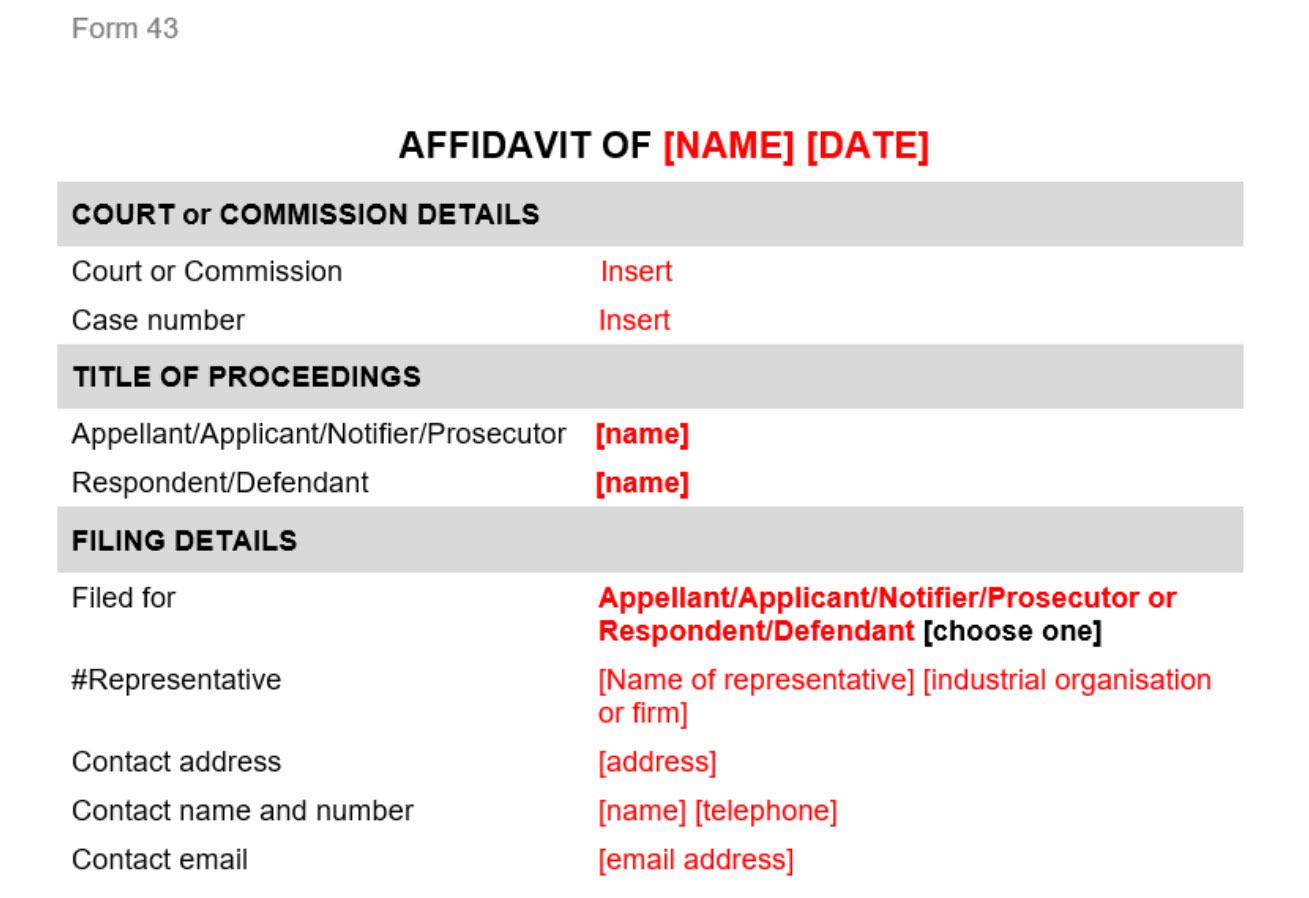
Page two must:
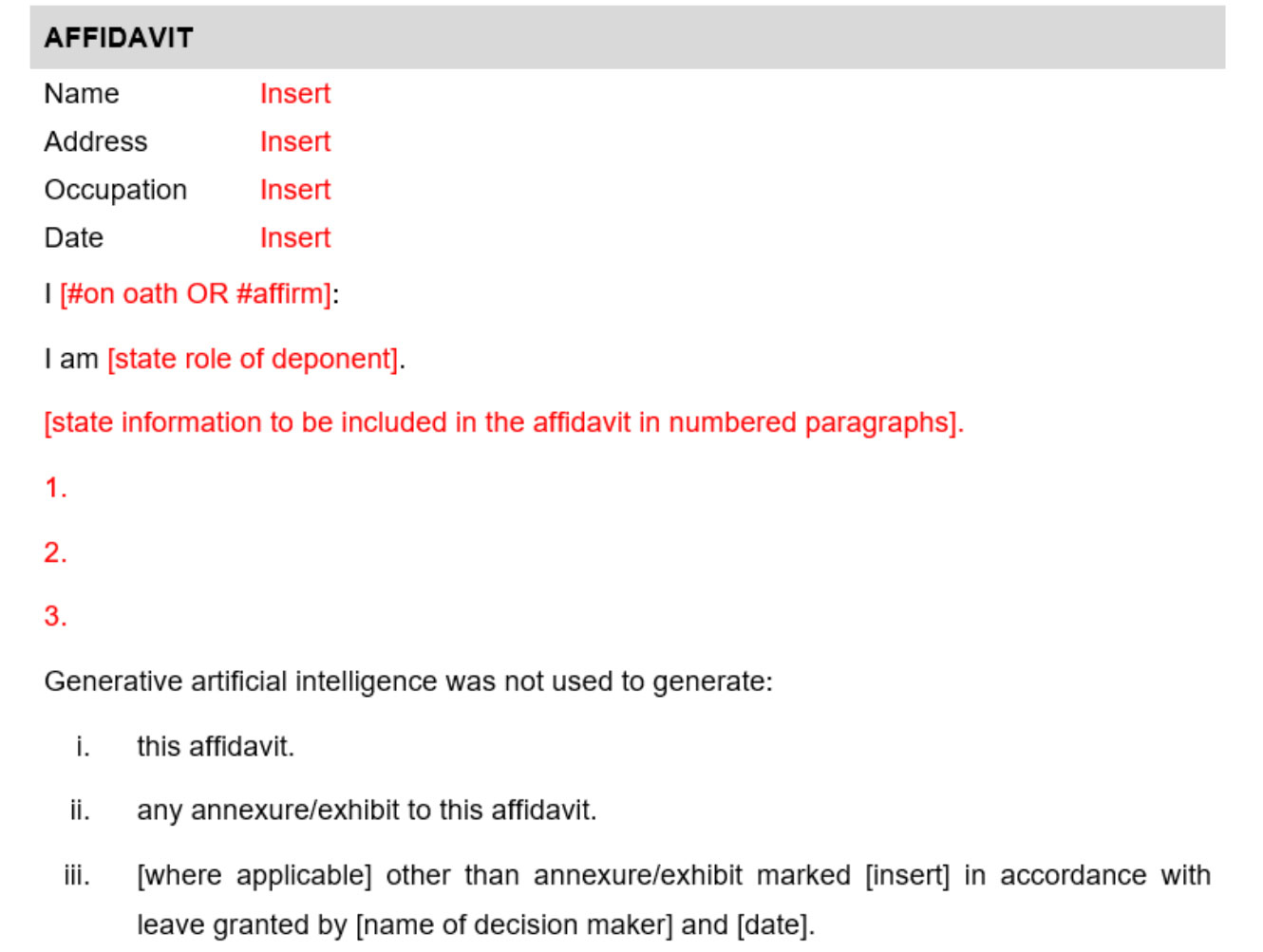
The jurat or signature panel at the end of the affidavit is where the deponent and the authorised witness both sign the document. The jurat cannot appear on the last page alone. There must be at least one paragraph of text before the jurat.
An authorised witness under section 26 of the Oaths Act 1900 (NSW) (Oaths Act) includes:
The Department of Communities and Justice has a JP Register that can be accessed here. An interpreter can be accessed through Service NSW if needed.
The deponent must sign the affidavit in the presence of the authorised witness. Every page of the affidavit must also be signed by the deponent and authorised witness.23
The authorised witness must see the face of the deponent24 and confirm their identity with an approved identification document (ID) if they have not known them for at least 12 months.25 The authorised witness may request any face covering that prevents identification to be removed unless an exemption applies.26
Signatures cannot be digital in accordance with Clause 5 of the Electronic Transactions Regulations 2017 (NSW). This means that signatures must be in wet ink.
The approved ID must include the deponent’s photo, and the name on the ID must match the name on the affidavit.
Approved ID under Schedule 2 of the Oaths Regulation 2024 (NSW) (original or certified copy)27 can include:
The document relied upon must not be expired, cancelled and must be in English (or provide a certified English translation).28 Otherwise, the authorised witness will not be able to sign the affidavit.
The affidavit may not be used if it has been edited or altered in any way after it has been signed. This includes any text being inserted, erased or otherwise altered.
The only exception is if an affidavit is edited or altered and the same authorised witness and deponent initial the change or, in the case of an erasure, rewrites the text in the margin of the affidavit any words or figures written on the erasure and signs or initials them.29
Annexures and exhibits can be used in conjunction with an affidavit.30 An annexure is a document attached to the end of an affidavit that provides additional information in support of something said in a corresponding paragraph, while an exhibit is a document or object referred to in an affidavit but kept separate from the document.
Annexures should be referred to by a bold letter in the affidavit. For example, “I emailed my boss on 1 October 2025. Annexed to this affidavit and marked with the letter ‘A’ is a copy of the email.” Write the identifying letter at the top of each annexure and attach the documents in alphabetical order at the back of the affidavit.
A party may file multiple affidavits with the Commission that refer to the same document. The same reference letter should be used if a secondary affidavit refers to a document that has been annexed to a previous affidavit. Any documents previously filed with the Commission should not be annexed to an affidavit.
Annexures and exhibits to an affidavit must be identified by a certificate signed by the authorised witness before whom the affidavit is executed.31
An exhibit to an affidavit is something that cannot be filed, such as an audio or video recording.32 The party must serve the exhibit in conjunction with the affidavit by:
Any person who wilfully and knowingly makes a false statement in the affidavit may be found guilty of perjury.34 The prosecution must be commenced with the approval of the NSW Attorney General.35
Every person wilfully swearing falsely in any affidavit made before any authorised witness shall be deemed guilty of perjury and be subject to the same penalties that apply to a person who has wilfully sworn falsely in open Court.36
1 Industrial Relations Commission Rules 2022 (NSW) r 3.3(1).; 2 Generally, s 130 Dispute Notifications can be notified to the Registrar directly, with a Notice of Motion.; 3 Ibid r 6.8(1).; 4 Ibid r 6.9.; 5 Ibid r 7B.2(3).; 6 Ibid r 7D.3(7).; 7 Ibid r 7.3.; 8 Ibid r 8.8A.; 9 Ibid r 7B.4.; 10 Ibid r 7.8.; 11 Ibid r 7C.3(2)., 12 Ibid r 35.8(2).; 13 Ibid r 35.3B(2).; 14 Ibid r 35.8(1).; 15 Uniform Civil Procedure Rules 2005 (NSW) r 35.3(3).; 16 Papakosmas v The Queen (1999) 196 CLR 297 at [81].; 17 Evidence Act 1995 (NSW) s 55(1).;18 Uniform Civil Procedure Rules 2005 r 35.3B(3).; 19 Ibid r 35.3B(1).; 20 Ibid r 35.3B(2).; 21 Ibid r 35.3A.; 22 Oaths Act 1900 (NSW) s 26.; 23 Uniform Civil Procedure Rules 2005 (NSW) r 35.7B.; 24 Ibid s 34(1).; 25 Oaths Regulation 2024 (NSW) cl 5.; 26 Oaths Act 1900 (NSW) s 34(3); Oaths Regulation 2024 (NSW) cl 4.; 27 Ibid (NSW) cl 6(1).; 28 Ibid cl 6(2).; 29 Ibid r 35.5.; 30 Ibid r 35.6(1).; 31 Ibid 35.6(2)-(4).; 32 Ibid r 35.6(5).; 33 Ibid r 35.6(6).; 34 Ibid s 33(1).; 35 Ibid s 33(2).; 36 Ibid s 29.
Last updated: